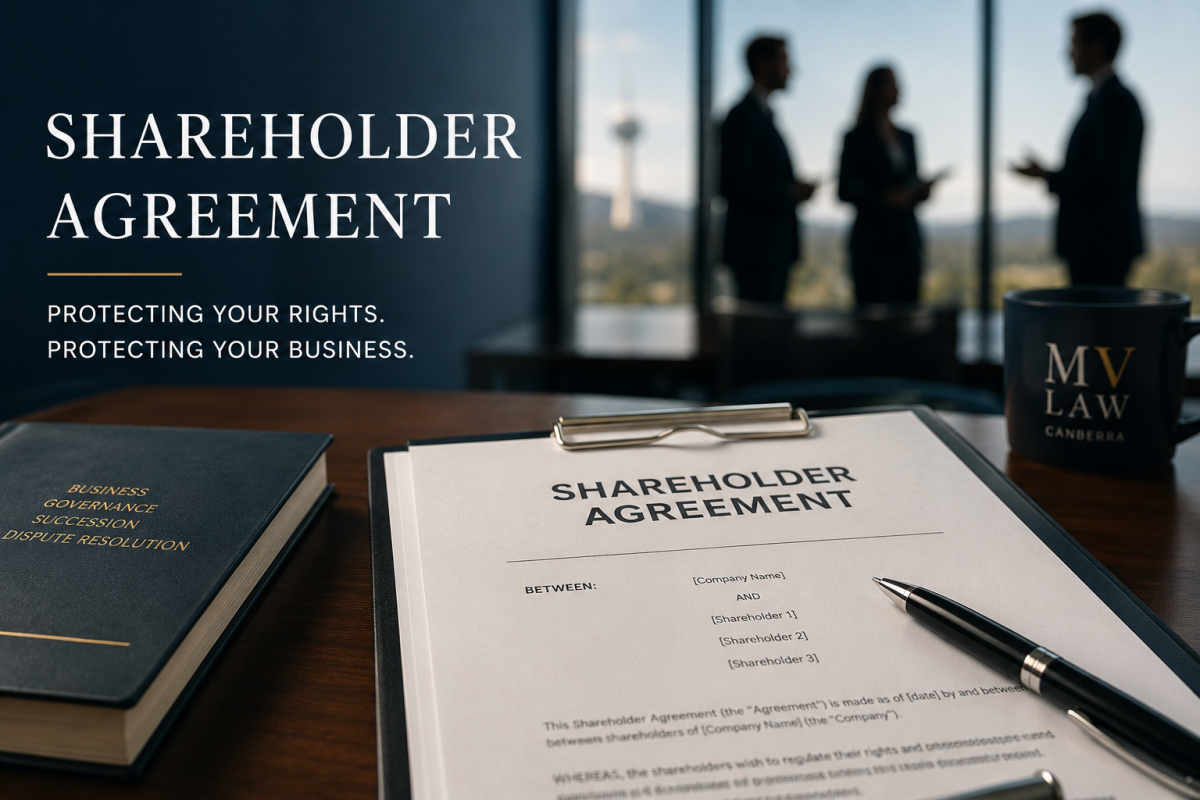
Why every business with more than one owner needs a shareholders’ agreement — and what happens when there is not one
Businesses are dynamic. They grow, evolve, restructure, and adapt to changing market conditions. Shareholders come and go. Some retire, some lose interest, some want to sell, and others simply no longer share the same vision for the company. New investors may enter the picture, relationships between founders may deteriorate, or the business may require a major restructure to remain competitive.
These events are not unusual — they are part of the natural lifecycle of many businesses. What separates businesses that navigate these changes smoothly from those that descend into costly disputes is often one critical document: a well-drafted shareholders agreement.
Where no formal agreement exists, the consequences are predictable and almost always unpleasant, as every significant decision becomes a negotiation, and every negotiation carries the potential to become a dispute. Those disputes — about exits, valuations, governance, and competing obligations — rarely resolve themselves quickly or cheaply. The parties engage lawyers. Positions harden. Legal costs accumulate. What might have been a straightforward restructure or an orderly change of ownership becomes a protracted and expensive contest, with significant stress for everyone involved and real risk to the business itself.
What is a Shareholders’ Agreement?
A shareholders’ agreement is:
- a private contract between the shareholders of a company — and usually the company itself — which governs the relationship between them, and typically include:
(a) clear split between decision-making powers of the board of directors and those that rest with the shareholders;
(b) rights and obligations of a shareholder to sell their shares,
(c) pre-emptive rights
(d) procedures and formulas to value shares
(e) consequences when a shareholder becomes incapacitated, retires, or passes away or is in breach of their obligations under the Shareholders Agreement, forcing a sale of their shares
(f) how to resolve deadlocks or disputes
(g) Protection for minority shareholders
(h) circumstances under which new investors can be introduced; and
(i) capital raising, restraints, confidentiality, and reserved matters. - separate from the company’s constitution, creating a more tailored framework for company governance and decision making, noting that typically most:(a) Shareholders’ agreements take precedence over a Company’s Constitution, to the extent of any inconsistencies; and
(b) Constitutions specify that the ‘Replaceable Rules’ under the Corporations Act 2001 (Cth) do not apply to that company; - not a sign of distrust between business owners. Rather, it is a clear expression of mutual respect — a shared commitment to knowing the rules before the game begins, noting that the document does not need to be long or complicated.
Rather than scrambling to negotiate terms during an emotionally charged situation, shareholders can simply refer to the agreed provisions and understand their respective rights and obligations.
What we see in practice
We advise shareholders on a daily basis. Our first question is “do you have a shredders Agreement?” if so, we can address the issues at hand by referring to the relevant provisions.
Having a shareholders’ agreement is of course far better than not having one. But an agreement that made sense when the business was first established may no longer reflect the realities of the relationship, the structure of the business, or the respective interests of the parties as they stand today. Provisions that were acceptable — or simply went unnoticed — at the time of signing can prove seriously problematic when they are actually called upon. These agreements usually sit in a drawer, unreviewed and untested, until crunch time – an that’s when they often disappoint as they may no longer be accurate, current, and genuinely fit for purpose.
Imagine a founder that wishes to exit the business while another shareholder wants to retain control. If there is no agreed mechanism for valuing shares, disagreement quickly arises over what the departing shareholder’s interest is worth. One side may rely on optimistic future projections while the other points to current financial pressures. Negotiations become strained, positions harden, and mistrust develops.
A shareholders’ agreement should clearly specify a valuation mechanism, so that the valuation methodology is agreed before any shareholder wishes to exit. Typically an independent expert is appointed on agreed terms, applying agreed principles.
Similarly, where relationships between shareholders break down, uncertainty around decision-making authority, voting rights, or exit mechanisms can paralyse the business.
This is particularly important when protecting minority shareholders from situations where a majority shareholder effectively controls both company operations and the minority’s ability to exit their shareholders investment.
A shareholders agreement should address related-party transactions explicitly, requiring that they be conducted on arm’s length terms and approved by shareholders other than the interested party. It should ensure existing shareholders choose whether related-party arrangements are in the best interests of the company and its current shareholders.
Where a majority shareholder is also a landlord, franchisor, financier, or supplier to the company, those relationships should also be disclosed, documented, and governed. A shareholders agreement is an appropriate place to do that.
The Cost of Not Having a Shareholders Agreement
Once lawyers become involved in resolving shareholder disputes, costs can escalate rapidly. Legal fees, valuation experts, forensic accountants, and court proceedings can consume substantial time and money. Equally significant is the stress these disputes place on directors, employees, and the broader business.
The risks are not merely personal. Prolonged shareholder disputes can:
- Disrupt business operations
- Damage relationships with staff, customers, and suppliers
- Delay strategic decisions
- Discourage investors and financiers
- Harm the company’s reputation
- Reduce the overall value of the business
In extreme cases, unresolved disputes can threaten the survival of the business itself.
Conclusion
No business owner expects shareholder disputes or major restructures at the beginning of a venture. Yet change is inevitable in business (as in life generally), and uncertainty can quickly become expensive when there is no clear framework to guide decision-making between the parties.
A well-drafted shareholders agreement provides certainty, protects relationships, minimises disputes, and safeguards the long-term stability of the business and the parties.
If your business has multiple owners, a properly drafted shareholders agreement is one of the most important legal protections you can have in place. At MV Law, we help business owners across Canberra and the ACT and surrounding regions prepare, review, and negotiate shareholders agreements that are practical, commercially realistic, and designed to reduce the risk of costly disputes later on.
Whether you are starting a new business, bringing in investors, restructuring ownership, or dealing with a shareholder dispute, our team can provide clear legal advice tailored to your situation.
Contact MV Law today to discuss your shareholders agreement or business dispute matter. A well drafted shareholders agreement is often the difference between a structured commercial process and a costly legal battle.
MV Law Canberra
Ph: (02) 6279 4444
Email: info@mvlaw.com.au