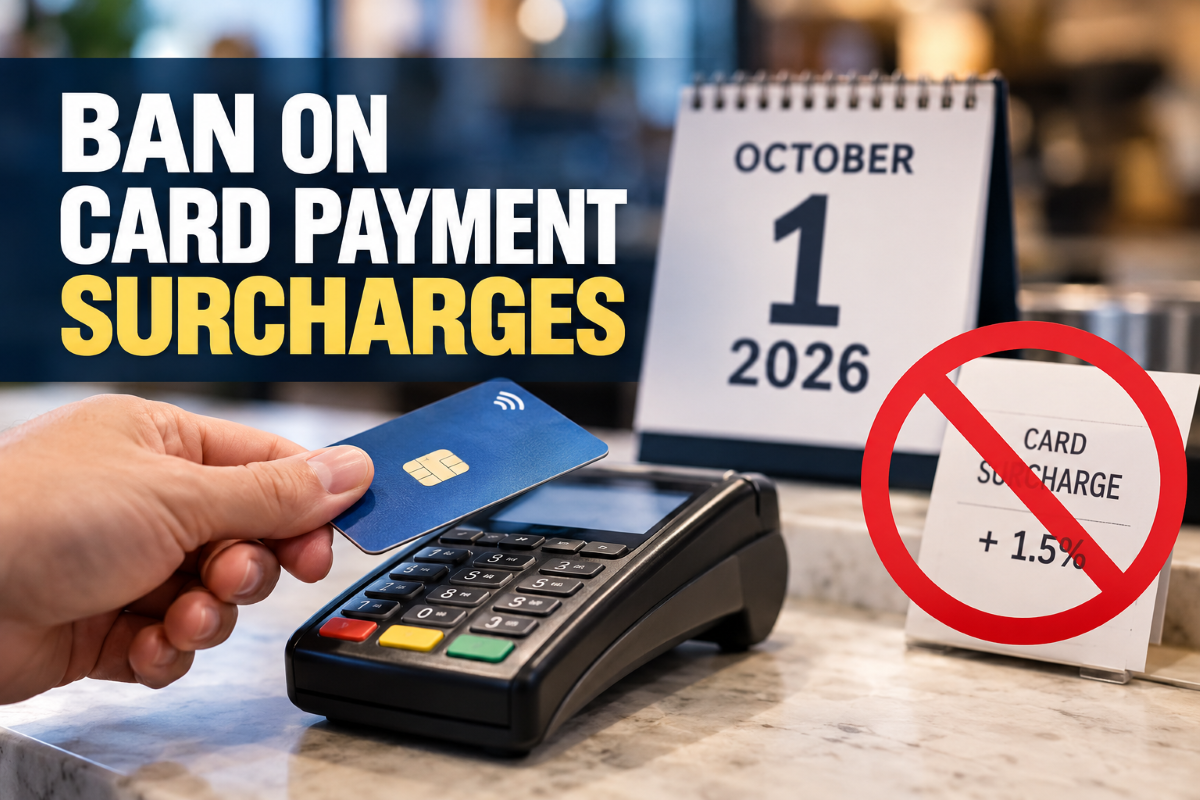
Businesses will no longer be able to add surcharges to card payments on major networks on and from 1 October 2026 (Effective Date).
THE CHANGE
The Reserve Bank of Australia (RBA) is removing surcharges on debit, prepaid and credit card payments made through designated eftpos, Mastercard and Visa networks. Each of those networks, which the RBA formally regulates, has introduced a ‘no-surcharge’ rule from the Effective Date. The RBA’s authority derives from the Payment Systems (Regulation) Act 1998 (Cth) to regulate payment systems and enforce standards.
American Express, UnionPay and PayPal have also decided to remove surcharging from the same date, although they are not currently subject to formal regulation by the RBA.
| Network | Surcharging permitted before 1 October 2026 | Surcharging permitted from 1 October 2026 |
|---|---|---|
| eftpos (debit and prepaid) | Yes | No |
| Mastercard (credit, debit and prepaid) | Yes | No |
| Visa (credit, debit and prepaid) | Yes | No |
| American Express (credit) | Yes | No |
| PayPal | Yes | No |
| UnionPay | Yes | No |
Source: Reserve Bank of Australia, 2026.
WHAT IS NOT AFFECTED
The ban applies only to card payment surcharges. Weekend and public holiday surcharges, booking fees and service fees are not affected, provided they apply regardless of how the customer pays.
Two points of law are particularly relevant:
Single price (s 48 Australian Consumer Law (ACL)): businesses must display a single price that includes all mandatory charges. If card is the only payment option, a compulsory surcharge must be included in the single price.
Misleading conduct: relabelling a card surcharge as a ‘processing fee’ or another type of charge is a breach of the ACL prohibitions on misleading or deceptive conduct and false or misleading representations.
PRACTICAL STEPS FOR BUSINESSES
- Who can help: the payment service provider used by a business is best placed to help on card surcharges removal, noting most of such businesses have expressed to the RBA an intention to remove the surcharging functionality on terminals they provide to businesses by the Effective Date.
- Review current surcharges: confirm they do not exceed the cost of acceptance under current law, calculated from the last 12 months of costs for each payment method.
- Keep records: retain merchant service fees, transaction fees and other acceptance costs, in case a surcharge is challenged.
- Monitor network rules: from the Effective Date, check the rules of each network accepted, liaising with the payment processor or acquiring bank as needed.
- Review pricing: noting that businesses will still incur costs when accepting card payments after surcharging is removed, consider including these costs in the business overall pricing, to account for the lost surcharge revenue – consider shopping around for different payment service providers, or encouraging lower-cost payment methods.
- Train staff: ensure staff handling pricing and payments understand the current requirements and the above changes.
RISKS
- Contract risk: from the Effective Date, surcharging on card payments breaches card network’s rules. Enforcement action stems from the business’ agreements with its payment processor or bank, and will not rest with the ACCC. Businesses should be mindful to remove such surcharges from their current contracts with their clients.
- Consumer law risk: calling a card surcharge a “processing” or “service” fee will be misleading conduct under the ACL. Weekend and public holiday surcharges are fine if they apply however the customer pays.
ADVICE FOR BUINESSES
We recommend that businesses review their merchant agreements and pricing ASAP (before the Effective Date), and ensure they remove all card surcharges with effect on and from the Effective Date.
Feel free to reach out to Massimo Di Maio of our Corporate & Commercial Team if you have any questions on this article or need assistance to ensure compliance with this new regime.
SOURCES
- Australian Competition and Consumer Commission (ACCC) v CLA Trading Pty Ltd t/as Europcar (2019) 138 ACSR 207.
- Competition and Consumer Act 2010 (Cth), Section 48.
- Paypal, “Policy Updates,” PayPal https://www.paypal.com/au/legalhub/paypal/upcoming-policies-full
- Reserve Bank of Australia, “Frequently Asked Questions – Removal of Card Payment Surcharges from 1 October 2026,” Reserve Bank of Australia (September 17, 2026) https://www.rba.gov.au/payments-and-infrastructure/review-of-retail-payments-regulation/2026-03/conclusions-paper/faqs/
- Visa Inc., “Visa Supports the Reserve Bank of Australia’s Direction to Remove Surcharging from 1 October 2026,” Visa (June 10, 2026) https://www.visa.com.au/about-visa/newsroom/press-releases/visa-supports-the-reserve-bank-of-australias-direction-to-remove-surcharging-from-1-october-2026.html
MV Law Canberra
Ph: (02) 6279 4444
Email: info@mvlaw.com.au